Carrying a Revolver: What Every Owner Should Know
Revolvers don't carry like semi-autos. Here's what actually matters when you carry a wheelgun — the cylinder problem, the carry positions that work, holster fit and retention, and how to practice the draw.
Carrying a Revolver: What Every Owner Should Know
The revolver never went away. Walk any range in the country and you'll still see J-frames riding in pockets, .357s on hips under a jacket, and big-bore single-actions on the belts of hunters and Cowboy Action shooters. They're simple, they're forgiving of neglect, and they chamber cartridges that a lot of compact semi-autos can't handle.
But a revolver does not carry like a semi-auto, and gear shaped for a flat, slab-sided pistol usually works poorly for a wheelgun. If you're carrying a revolver in a holster that was never really built for one — or you're about to start — this guide covers what actually matters: the shape problem, where on the body a revolver wants to ride, how fit and retention change when there's a cylinder in the picture, and what to practice.
This article is for general informational purposes only and is not legal advice. Firearms laws change frequently and vary by state and locality — always verify current laws with official sources or a qualified attorney before carrying.
The Revolver Shape Problem
A semi-auto is mostly flat. Its widest point is usually the grip or the controls, and it presses against the body in a fairly even plane. A revolver is the opposite: the cylinder is the widest part of the gun and it sits right in the middle, at roughly the same height as your belt line. That single fact drives almost every carry decision you'll make.
Three consequences follow. First, concealment is a problem of the middle, not the muzzle — a revolver tends to push the cover garment out at the waist rather than at the bottom of the holster. Second, the grip frame on most revolvers sits at a more vertical angle than a modern striker gun, which means grip-print shows up faster unless the holster puts real cant into the setup. Third, if your revolver has an exposed hammer spur, that spur is a snag point on every shirt tail and jacket lining you own.
None of this makes a revolver harder to carry. It makes a revolver harder to carry badly. A holster molded around the actual cylinder, with the right cant and a properly boned fit, solves most of it. A generic pouch does not. If you want the deeper breakdown of body positions themselves, our guide to concealed carry positions covers the trade-offs of each clock position in detail.
Where a Revolver Wants to Ride
Strong-side OWB, 3 to 4 o'clock. The classic answer, and still the best one for anything with a 3-inch barrel or longer. An outside-the-waistband rig keeps the cylinder off your skin, rides high enough to clear a seatbelt, and gives you the cleanest draw of any position. Under a jacket, an untucked overshirt, or a vest, it conceals fine. Browse OWB holsters if this is where you plan to live.
IWB behind the hip, 4 to 5 o'clock. For snub-nose revolvers and mid-size .38s, inside-the-waistband at the kidney gets the cylinder behind the widest part of your torso, where it hides in your natural curve instead of fighting it. Expect to size up a belt line and expect more break-in than an OWB rig. Our IWB holsters are cut for exactly this.
Pocket carry, J-frames only. A five-shot snub in a proper pocket holster is one of the most genuinely concealable setups that exists — and one of the most abused. The holster has to break up the outline, stay in the pocket on the draw, and cover the trigger completely. Loose in a pocket is not carrying; it's transporting. We wrote a full breakdown in pocket carry done right.
Cross-draw and field carry. Drivers, hunters, and anyone who spends hours seated or wearing a pack often end up here. A cross-draw or chest rig keeps a 4- to 6-inch barrel accessible when a strong-side holster is pinned under a seatbelt or a hip belt. This is also the natural home of the Western holsters that big single-actions were designed around.
Appendix. Possible with a small-frame revolver, difficult with anything bigger. The cylinder width that hides so well behind the hip is exactly what prints when it sits over the front of your pelvis, and the vertical grip angle works against you when you sit down.
🔶 Product Spotlight: The Backdraft TB
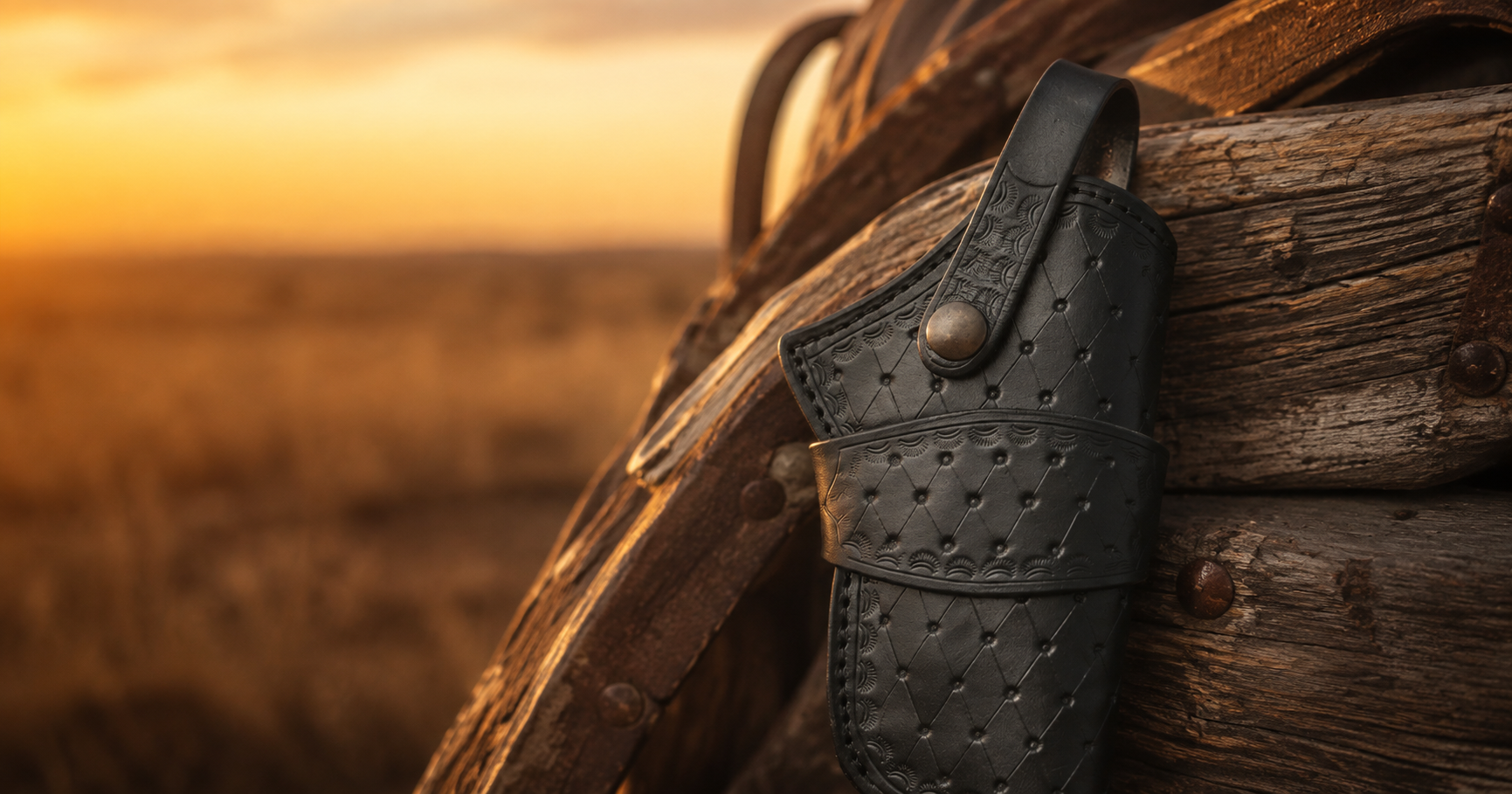
The Backdraft TB is a thumb-break OWB rig built for revolvers — it fits everything from a J-Frame up through an N-Frame .44 Magnum, and it handles single-actions with barrels up to 7.5 inches. It's offered in ambidextrous configuration, so left-handed shooters get the same holster as everyone else, and the thumb break gives you active retention for field and open-carry use. $69.00.
Fit, Retention, and the Revolver Draw
Holster fit for a revolver is driven by two measurements most people don't check before they buy: frame size and barrel length. A holster cut for a 2-inch J-frame will not hold a 3-inch model correctly — the muzzle bottoms out or hangs past the holster mouth, and the gun sits at the wrong height. Get both numbers off your revolver before you order anything.
The good news is that a cylinder gives leather something to grab. A properly molded leather holster forms a shelf around the cylinder that produces real passive retention without a strap — the gun seats with an audible click and stays there when you move. That's the payoff of hand-boning, and it's why a molded leather rig gets better as it takes the shape of your specific gun rather than worse.
For field use, open carry, or anything involving running, climbing, or riding, add active retention. A thumb break is the traditional answer for a revolver and still the right one: it clears with the same thumb motion that establishes your firing grip, so it costs almost nothing in draw speed once it's trained.
One rule that doesn't bend: reholster slowly, with your eyes on the holster, and only after the threat is over. A revolver's trigger has a long, heavy pull, which buys you margin — but margin is not a substitute for looking.
Leather, Break-In, and the Belt Underneath It
A new leather holster is supposed to be tight. That's not a defect; that's the fit you paid for, and it loosens to your exact revolver over the first week or two of wear. Work through the process deliberately rather than forcing it — our guide on breaking in a leather holster walks through the method that doesn't stretch the mouth permanently.
Every Tagua holster is handcrafted, and has been since 2005 — cut, molded, stitched, and finished by artisans rather than run off a production line. Full-grain leather does something synthetic materials simply don't: it darkens, it takes on the oils from your hands and the shape of your body, and after a season of carry it looks like yours and nobody else's. A rigid polymer shell carries the same on day one and day one thousand. Leather earns its character.
None of it works on a bad belt. A revolver is heavy — a steel-frame .357 with a 4-inch barrel runs well over two pounds loaded — and a fashion belt will roll, sag, and let the holster tip away from your body until the whole rig prints. A purpose-built gun belt is not an accessory to the holster; it's half the holster. We made the case in why a real gun belt matters, and you can see the full lineup in gun belts.
Reloads and What to Actually Practice
Revolver reloads are a skill, not a feature. Speed strips are flat, pocketable, and slow. Speedloaders are faster and bulkier. Moon clips are fastest of all but only if your cylinder is cut for them. Pick one, carry it in a consistent place, and practice it — a reload you've never rehearsed is a reload you don't have.
Beyond that, the practice list is short and it's the same list as any other carry gun. Dry-practice the draw from your actual holster, wearing your actual cover garment, until clearing the shirt and establishing the grip is one motion. Practice the thumb break if you run one. Practice reholstering slowly. Do it enough times that the first repetition of the day looks like the fiftieth.
If you're shopping for the rig itself, start with our breakdown of the best leather holster for a J-frame or trail gun — it goes model by model through what fits what.
Ready to Carry Your Revolver Right
Every Tagua holster is made to order and handcrafted by our artisans, and ships within 15 business days. Free shipping on orders over $100 (continental US). And because we stand behind what leaves our hands, every holster carries our Lifetime Warranty.
Find the rig your revolver deserves — browse OWB holsters, IWB holsters, or the Western lineup.
Frequently Asked Questions
How do you conceal a revolver cylinder?
Move the gun to where your body is already widest — behind the hip at 4 to 5 o'clock — so the cylinder sits in your natural curve instead of pushing against a flat plane. A holster with real cant and a close-to-body ride height does most of the rest, and a structured cover garment beats a thin clingy one every time.
Can you carry a revolver in an IWB holster?
Yes, and it's a common setup for snub-nose and mid-frame revolvers. Expect to go up a size in your waistband and expect a real break-in period, since the cylinder has to find its place between you and your belt. Larger-frame revolvers with 4-inch and longer barrels generally carry better OWB.
What barrel length is best for carrying a revolver?
Two to three inches is the concealment sweet spot for daily carry; four inches and up gives you more velocity and a better sight radius but needs an OWB or field rig to carry comfortably. Whatever you choose, order your holster for that exact barrel length — holsters are not interchangeable across barrel lengths.
Do I need a thumb break on a revolver holster?
For everyday concealed carry under a cover garment, a properly molded leather holster provides enough passive retention on its own. For open carry, hunting, horseback, or anything physically active, a thumb break is worth the fraction of a second it costs — it keeps the gun seated when you're moving hard.
Is it legal for me to carry a revolver where I live?
That depends entirely on your state and locality, and the rules change. This article is for general informational purposes only and is not legal advice — always verify current laws with official sources or a qualified attorney before carrying.