Cross-Draw Carry for Drivers, Hunters & Desk Work
Cross-draw carry puts the gun where your hand can reach it when you're seated, belted in, or wearing a pack. Here's who it works for, how to set it up, the muzzle-discipline trade-off, and what to look for in a cross-draw holster.
Cross-Draw Carry for Drivers, Hunters & Desk Work
Most carry advice assumes you're standing up. Strong-side at 3 or 4 o'clock is the default for good reason — it's natural, fast, and easy to train. But a lot of people spend most of their carry day sitting: behind the wheel, at a desk, in a tractor cab, or on a tree stand with a pack strapped around their hips. In those positions, a strong-side holster ends up pinned under a seatbelt, jammed against an armrest, or buried beneath a hip belt.
That's the problem a cross-draw holster solves. It moves the gun to the front of the support side, where your strong hand can reach across and draw without fighting the seat or the gear you're wearing. It's one of the oldest carry methods there is, and for the right person it's still one of the most practical. If you're still sorting out which position fits your day, our overview of concealed carry positions lays out every clock position side by side.
This article is for general informational purposes only and is not legal advice. Firearms laws change frequently and vary by state and locality — always verify current laws with official sources or a qualified attorney before carrying.
What Cross-Draw Carry Actually Is
A cross-draw holster rides on the support side of the body — roughly 10 to 11 o'clock for a right-handed shooter — with the grip angled forward, toward the strong hand. To draw, you reach across your torso, establish a grip, and pull the gun out and forward toward the target.
The key detail is cant. A strong-side holster usually tilts the grip rearward; a cross-draw holster tilts it the opposite way, butt-forward, so your hand meets the grip at a natural angle instead of bending the wrist. Get the cant wrong and the draw feels awkward and slow. Get it right and it's surprisingly smooth — especially seated, where your hand already rests near your belt line.
Cross-draw isn't the same as appendix carry. Appendix sits in front of the strong-side hip with the muzzle pointing straight down; cross-draw sits further around on the support side with the muzzle angled back. The two feel similar at a glance and behave very differently in practice.
Who Cross-Draw Works For
Drivers. This is the big one. In a car, a strong-side holster sits exactly where the seatbelt buckle and the seat bolster live. A cross-draw holster keeps the grip accessible above the lap belt and clear of the door, which matters whether you spend twenty minutes a day commuting or ten hours a day on the road.
Hunters and backcountry carry. A loaded pack with a hip belt covers everything from about 2 to 10 o'clock on the strong side. Cross-draw sits forward of the hip belt, where you can still reach it — and it works well with a longer barrel, since the gun rides at an angle instead of straight down against your thigh. For more field options, see our guide to field carry for hunters, and if you're weighing a chest rig instead, read best chest holster for hunting.
Desk and seated work. If you're seated most of the day, a strong-side gun pressed against a chair back gets uncomfortable fast. Cross-draw keeps the gun in front of you, where it's more comfortable and easier to reach from a chair.
Revolver and single-action owners. Cross-draw has deep roots in the Western carry tradition, and big-frame revolvers with long barrels still ride well there. Our recent guide to carrying a revolver covers why the cylinder shape changes where a wheelgun wants to sit, and our Western holsters include rigs built around that heritage.
🔶 Product Spotlight: The Quick Draw 4 in 1
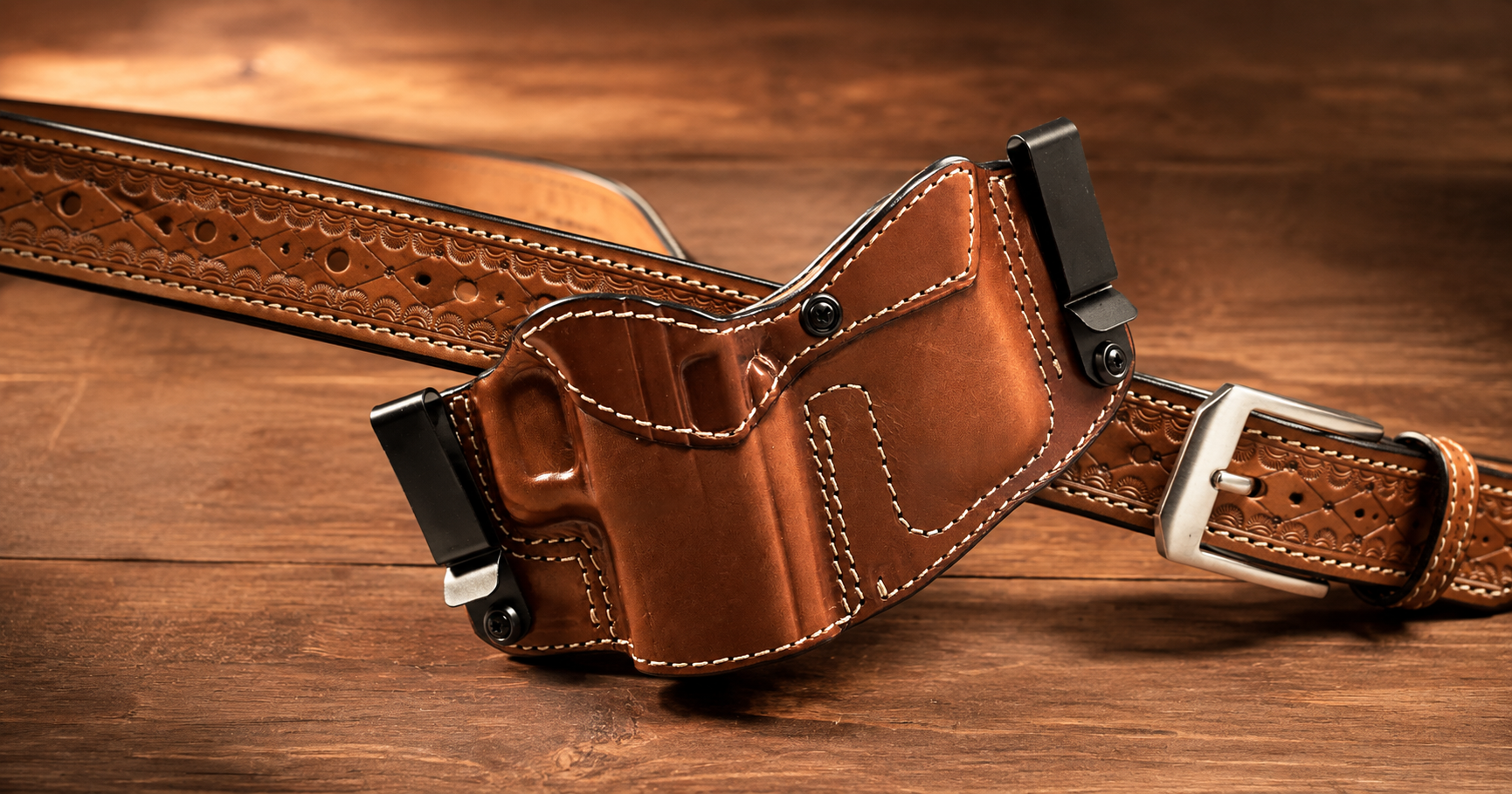
If you want cross-draw without committing to a single-purpose rig, the Quick Draw 4 in 1 gives you four carry positions from one holster: IWB, belt, cross-draw, and strong-side. It's an open-top design with deep-molded leather that wraps the trigger guard for friction retention, an optic-ready cut for popular red dots, and double-stitched stress points. Fitment spans 9 codes from sub-compact .380s up through the Glock 19 and 1911 platforms, in Black or Tan, right- or left-hand. $62.00.
The Trade-Offs You Need to Know
Cross-draw earns its place, but it isn't free. Three things deserve an honest look before you commit.
Muzzle direction on the draw. Because the gun has to travel across your body, the muzzle sweeps a wider arc during the draw than it does from strong-side. Done carelessly, that arc can cross your own support arm or anyone standing beside you. The fix is technique: keep your support hand high and clear against your chest, keep your finger off the trigger until the gun is on target, and drive the gun forward rather than swinging it. Some ranges don't allow cross-draw for this reason — always check the range's rules before you practice there.
Concealment while standing. A gun at 10 o'clock with the grip angled forward sits on the front of your body, which is harder to hide under a short shirt than one behind the hip. Cross-draw conceals best under an open jacket, vest, or overshirt — the same cover garments drivers and hunters tend to wear anyway.
Retention at close range. A forward-facing grip is easier for someone in front of you to reach. A holster with solid molded retention helps, and so does awareness. For open carry or field use, a thumb break adds a real layer of security.
None of these are dealbreakers. They're the reasons cross-draw is a specialist's position rather than a universal default — and why many people who carry it daily use a holster that can switch back to strong-side when they're up and moving.
Setting Up a Cross-Draw Rig That Works
Start with the belt. A cross-draw holster sits on the front of your body, where the belt bends more sharply than it does at the hip. A flimsy dress belt lets the holster roll outward and tilt the grip away from your hand. A stiff, purpose-built gun belt keeps the holster locked at the angle you set. We made the full case in why a real gun belt matters, and you'll find the lineup in gun belts.
Set the cant, then test seated. Put the holster on, sit in the seat you actually use — car, desk chair, truck — and practice slow, unloaded draws. Adjust the position until your hand meets the grip without bending your wrist or twisting your shoulder. What feels right standing often feels wrong in a car, and vice versa.
Check your clearance. In a vehicle, make sure the seatbelt runs below the grip and the holster doesn't press into your ribs. Outdoors, confirm your pack's hip belt sits below or behind the holster, not on top of it.
Choose leather that holds its shape. A cross-draw holster works at an angle, so its mouth has to stay open for one-handed reholstering, and its molding has to hold the gun securely against gravity pulling sideways. Every Tagua holster is handcrafted — cut, wet-molded, and stitched by leather artisans, a tradition we've kept since 2005. Full-grain leather boned to your gun's contours grips it with real friction, and over weeks of wear it darkens, softens where it should, and takes on a patina that's yours alone. A rigid polymer shell feels the same on day one and day one thousand; good leather gets better. Give a new holster time to settle — our guide to breaking in a leather holster shows how to do it without stretching the mouth.
If you want a dedicated multi-position setup, browse our Multi-Draw holsters — they're built to move between cross-draw, strong-side, and IWB as your day changes. For open-carry and field use, our OWB holsters include thumb-break options for added retention.
Find Your Cross-Draw Setup
If you drive, hunt, or work seated, cross-draw can turn a gun you struggle to reach into one that's right where your hand already is. Every Tagua holster is made to order and ships within 15 business days, with free shipping on orders over $100 in the continental US, and it's backed by our Lifetime Warranty against defects in materials and workmanship.
Frequently Asked Questions
Is cross-draw carry good for driving? For many drivers, yes. A cross-draw holster keeps the grip above the seatbelt and away from the door, where a strong-side holster is often pinned. Test your setup in your own vehicle with an unloaded gun to confirm the belt and armrest don't interfere.
Is cross-draw safe? It can be, with sound technique. The main concern is the wider muzzle arc during the draw, so keep your support hand high and clear, your finger off the trigger until on target, and practice slowly. Some ranges don't allow cross-draw, so check range rules before training there.
Can I use a cross-draw holster for hunting with a pack? Yes — it's one of the best reasons to use one. Cross-draw sits forward of most pack hip belts, so the gun stays reachable when a strong-side holster would be covered. A thumb break adds retention for rough terrain.
Does one holster work for both cross-draw and strong-side? Some do. Multi-position holsters like the Quick Draw 4 in 1 are designed to switch between cross-draw, strong-side, belt, and IWB carry, so you can adjust as your day changes between driving and walking.
Is cross-draw carry legal? This article is for general informational purposes only and is not legal advice. Firearms laws change frequently and vary by state and locality — always verify current laws with official sources or a qualified attorney before carrying.